The Higher Lower Game
- 327
- 3.9
- Installs
- —
- Price
- Free
Screenshots
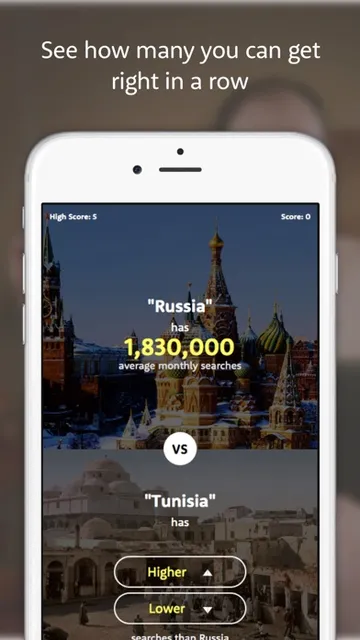
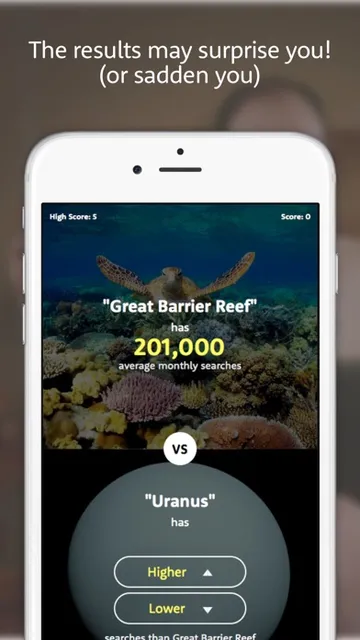

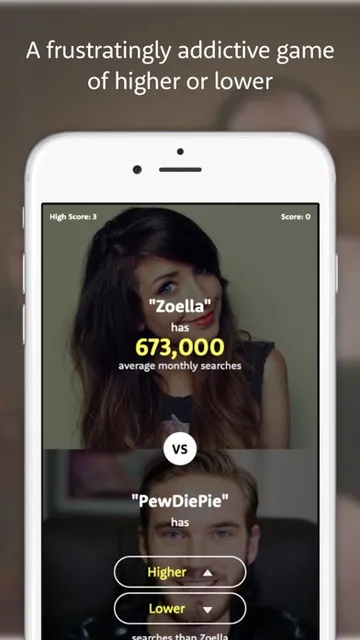
Analysis by Reviewed APKs
The Higher Lower Game is a quick trivia game built around one question: which of two search terms gets searched more? I like the idea because it turns everyday curiosity about celebrities, brands and current topics into a simple guessing challenge. It suits players who enjoy short, low-pressure quizzes and comparing instincts with friends. Its narrow format is also its main limitation: the fun depends on enjoying repeated rounds of the same basic choice.
One Guess at a Time
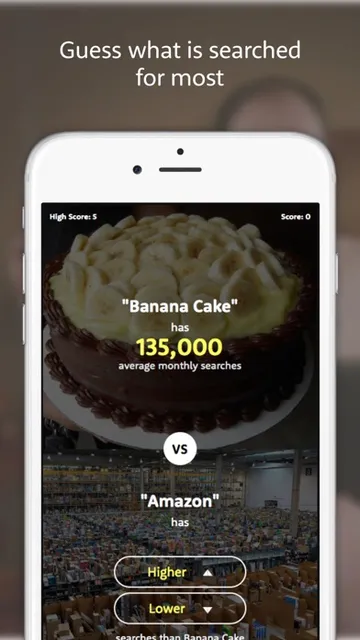
A typical round gives you two search terms and asks you to choose whether one has been searched more or less than the other. The objective is to get as many answers right in a row as possible. There is very little to learn before playing, so I can imagine opening it while waiting for a coffee or filling a spare minute without needing to plan a longer session.
The appeal is in making a snap judgment, then seeing whether my sense of what people search for lines up with the game’s answer. A comparison such as Starbucks versus Kim Kardashian gives the question a familiar, conversational feel. I found the premise easy to explain to someone nearby, which makes it a natural little quiz to pass around rather than a game that demands a long solo commitment.
A Narrow Trivia Niche
Compared with trivia games that ask for specific dates, names or facts, The Higher Lower Game is less about recalling an answer from memory and more about estimating public interest. That gives it a different kind of challenge: you may know both terms perfectly well and still have to guess which attracts more searches. It rewards cultural intuition and curiosity, rather than specialist knowledge or a broad set of quiz skills.
I would not pick it expecting a substantial collection of distinct game modes, a story, or a deep progression system. The material centers on choosing higher or lower between search terms, so the core experience stays focused. That simplicity is useful for quick play, but players who want varied rules, more elaborate challenges or a sense of building toward a larger goal may find the format repetitive.
Start With Your Instinct
In the first few minutes, I would treat each comparison as a reasoned guess rather than trying to overthink every term. Ask yourself which name is more likely to come up in a typical search, then commit. The game is built around getting answers right in a row, so a quick decision keeps the rhythm moving and makes it easier to notice the kinds of comparisons that catch you out.
It also helps to remember that familiarity and search popularity are not the same thing. I might recognize a subject more readily than its opponent without knowing which one draws more searches. That gap is part of the quiz’s appeal, and accepting it makes a wrong answer feel like a surprising result rather than a failure to study. Keep the session casual and focus on the streak as a simple score to beat.
More From Our News Desk

Zoom Meetings, Google Meet, or Teams: Which Is Easiest to Join?

How I Build a Free Streaming Lineup With Tubi

Why Crunchyroll Is the Default Anime App for So Many Fans

YouTube TV: A Practical Guide to Cutting Cable
Rummikub and the Small Comfort of Phone Games

TeamViewer Remote Control or AnyDesk for Helping Family?
Who Should Give It a Try
I would recommend The Higher Lower Game to people who like lightweight trivia, pop-culture comparisons and quick challenges that are easy to share aloud. It can work well as a small diversion during a break or as a conversational game when friends are already together. Because the rules are simple, you do not need to be a dedicated quiz player to understand what a round asks you to do.
Players who need lots of variety, deeper strategy or a clear long-term progression may bounce off. The central decision remains the same from comparison to comparison, and success depends on estimating search interest rather than mastering a complicated system. I would also be cautious about expecting the game to teach a complete picture of trends: its premise is a guessing quiz, not a detailed research tool.
The Higher Lower Game is a free iOS game from Code Computerlove. On the App Store, it has a 3.9 rating from 327 ratings. The store record gives its release date as July 5, 2016, and its latest update as April 12, 2018. The current version shown is 1.5.7.
The App Store marks the game as suitable for ages 12 and up, and it requires iOS 9.0 or later. The listed price is $0. The available store details do not provide an install count or specify advertising or in-app purchase information, so those are worth checking on the App Store before downloading.
The Appeal of a Simple Search Guess
Easy to Pick Up
The onboarding is essentially the rule itself: compare two search terms and choose higher or lower. That makes the game unusually approachable for a casual quiz. I do not need to memorize controls or learn a set of categories before a first round makes sense. The description’s examples, including a refugee crisis and Donald Trump, also show the kind of contrasting subjects the question can put side by side.
That clarity is a real strength when introducing the game to another person. I can explain the objective in one sentence and start asking for guesses. There is no need to build up a backstory or understand a complicated scoring scheme. The catch is that a straightforward premise does not automatically mean a wide-ranging experience; the core remains a sequence of similar popularity comparisons.
Streaks Set the Pace
The stated objective of getting the most correct answers in a row gives each decision a small amount of tension. A correct guess keeps the streak alive, while the prospect of being wrong makes even an easy-looking comparison feel worth considering. I like that this creates a lightweight reason to continue without turning a short quiz into a major commitment.
The pace is naturally shaped by how quickly I make a choice. I can play briskly when the terms seem obvious or pause to think when both feel plausible. The material does not describe a campaign or a series of difficulty levels, so I would approach it as a repeatable score-chasing activity rather than a game with a long, structured climb. That is convenient for short breaks, but less satisfying for players seeking steady new challenges.
Everyday Search Curiosity
The subject matter gives the comparisons their personality. The description points to contrasts such as Starbucks and Kim Kardashian, mixing a recognizable brand with a celebrity, and it also mentions current-affairs topics. That combination encourages a particular kind of curiosity: not simply whether I know a name, but whether I can guess how much public attention it attracts.
I find that premise works best when the pair itself prompts conversation. Someone can defend a guess based on what they see in everyday life, while another person may have a different sense of what is popular. The game does not need complicated rules to make that exchange enjoyable. Still, I would not assume that every possible topic or category is available; the supported description establishes search-term comparisons, not a full catalogue.
A Casual Spending Picture
The game is listed as free on the App Store, which makes it easy to consider as a small quiz to try. The store details give a price of zero dollars. They do not specify whether the experience includes ads or optional purchases, so I would check the current App Store information if those details matter to how I choose games.
That missing spending detail is worth keeping separate from the game’s design. The known premise does not rely on buying anything to understand the central activity: choose which term gets searched more and try to build a correct streak. I would avoid assuming that free means completely uninterrupted or that every feature has no cost; the store page is the sensible place to verify its current purchase and advertising details.
Keep Expectations Grounded
The game’s compact format is both its convenience and its main constraint. A quick round fits into spare time, but the same higher-or-lower decision anchors the experience throughout. If I want a quiz with changing mechanics or a substantial range of activities, this may feel too limited. It is better approached as a focused diversion than as a game meant to occupy every evening.
The available description does not establish whether play requires an internet connection, so I would check the App Store details if offline use is important. On iPhone or iPad, the stated requirement is iOS 9.0 or later. I would also keep in mind the 12+ age rating when deciding whether it is suitable for a younger player, rather than assuming that a simple quiz is intended for every age.
The Higher Lower Game has a clean, memorable idea and makes it easy to start guessing right away. I enjoy the way familiar names become a test of intuition, and the streak goal gives short sessions a little momentum. Its focused format does not offer much variety, but that is also why it works as a quick diversion.
I would recommend it to casual trivia fans who like pop-culture questions and friendly debates about what people search for. If you want a deeper game with multiple modes or a long progression path, look elsewhere. For an uncomplicated, bite-sized guessing challenge, this one is easy to understand and worth a try.
The Higher Lower Game Frequently Asked Questions
Is The Higher Lower Game free to play?
The Higher Lower Game is listed as free on the App Store, with a price of $0. Store details can change, so check the current App Store page before downloading if you want the latest information about availability or any costs associated with the game.
Does The Higher Lower Game have in-app purchases or ads?
The available store facts do not specify whether The Higher Lower Game includes in-app purchases or advertising. If either detail affects your decision, check the current App Store page for the latest information rather than assuming the free price means there are no ads or optional purchases.
Can I play The Higher Lower Game offline?
The supplied game information does not say whether The Higher Lower Game works offline. If you plan to play without a connection, check the App Store details or try the game in the situation where you need it. Online requirements may vary with the current version.
Which devices support The Higher Lower Game?
The Higher Lower Game is an iOS app and requires iOS 9.0 or later. Check the App Store page on your device for current compatibility details, since support may depend on the specific device and software version you use.
Is The Higher Lower Game suitable for children?
The App Store age rating for The Higher Lower Game is 12+. The game asks players to compare search popularity for terms, but families should use that rating when deciding whether it suits a particular child. Check the current App Store page for any updated age guidance.
Pros
- A simple higher-or-lower rule makes it easy to start a round quickly.
- Search-term comparisons turn familiar names into an entertaining test of intuition.
- The streak objective gives short sessions a clear, lightweight goal.
- Its conversational premise is easy to share with friends.
Cons
- The central guessing mechanic may feel repetitive over longer sessions.
- Players seeking varied modes or deep progression may find the format limited.
- The available game description does not establish whether offline play is supported.
- Category
- Trivia
- Version
- 1.5.7