Meowdoku!
- 407.42K
- 4.8
- Installs
- —
- Price
- Free

Screenshots





Analysis by Reviewed APKs
Meowdoku! is a casual logic puzzle built around placing cats on a board without breaking a few clear rules. It mixes Sudoku-style row and column constraints with colored regions and a no-touching rule, so each move asks you to reason rather than guess. I like the tidy premise: it suits short, focused breaks, though players who want a story or a busy collection of modes may find it spare.
A board full of deductions
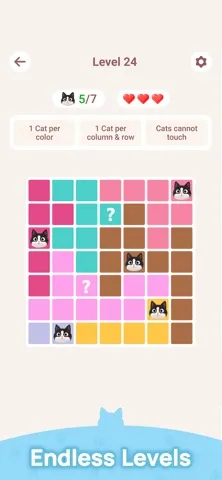
A typical puzzle starts with a board split into colored sections. The goal is to place exactly one cat in each section, while making sure no two cats share a row or column or sit next to one another, including diagonally. Those rules give each tile several things to satisfy at once. I find that the fun is less about reacting quickly and more about narrowing down where a cat can safely go.
You place a cat by double-tapping a tile, and mistakes cost one of your three hearts. That limited cushion makes a move feel meaningful without turning each board into a race. The puzzle asks you to think through the consequences before committing, then gives you the small payoff of a clean placement when the constraints line up. It is a compact loop: inspect the regions, eliminate impossible spots, and make a careful choice.
For logic fans, not collectors
Meowdoku! is a good fit if you enjoy Sudoku-like deduction but want a different set of constraints to work through. The colored territories add another layer beyond rows and columns, and the cats' personal-space rule makes diagonals matter too. That combination gives familiar logic-puzzle habits a fresh shape without asking you to learn a complicated set of controls or a long list of systems.
It is not a narrative adventure, a social game, or a broad puzzle collection, at least from the features described. The appeal is concentrated in the board itself, not character stories, competitive team play, or a sprawling progression of activities. Players who need constant novelty or a lot of visual spectacle may bounce off the minimalist approach. If a single well-defined logic challenge sounds appealing, the focused design is a strength.
Start by ruling tiles out
In the first hours, I would resist treating an empty tile as a likely answer just because it looks convenient. Check the colored section first, then consider the row and column restrictions and whether a cat would touch another one, even at a diagonal. Each rule removes possibilities, and the remaining options are the useful information. A quick scan of all three constraints before double-tapping should help preserve those three mistake hearts.
When a move feels uncertain, look for the region or line with the fewest plausible spaces and reason outward from there. The game is built around deduction, and its description explicitly warns that guessing is not a reliable shortcut. Daily puzzles offer a fresh board each day, while the global leaderboards give faster solvers a time to chase. I would treat speed as a later goal, after the rules feel second nature.
More From Our News Desk

Zoom Meetings, Google Meet, or Teams: Which Is Easiest to Join?

How I Build a Free Streaming Lineup With Tubi

Why Crunchyroll Is the Default Anime App for So Many Fans

YouTube TV: A Practical Guide to Cutting Cable
Rummikub and the Small Comfort of Phone Games

TeamViewer Remote Control or AnyDesk for Helping Family?
Who will enjoy it most
I would recommend Meowdoku! to players who like quiet brainteasers they can pick up for a few minutes, solve with concentration, and put down again. Its rules are easy to summarize, but the overlap between colored regions, rows, columns, and neighboring tiles creates room to think. The daily puzzles can also give regular players a simple reason to return without requiring a long session or a social commitment.
It may be a poor match for anyone looking for action, a story campaign, or a large variety of activities. The design keeps attention on one kind of logic puzzle, and the limited mistake allowance can be frustrating if you prefer to experiment freely. I also would not choose it for a player who wants elaborate rewards or constant new mechanics. The best audience is patient, curious, and happy to work a board out one deduction at a time.
Meowdoku! is a free casual game from OAKEVER GAMES PTE. LTD. on the Apple App Store. It has a 4.8 rating from around 407,000 ratings. The content rating is 12+, and it requires iOS 15.0 or later. Its current version is 1.23.0, with a release date of May 19, 2026.
The description presents the game as playable offline and says its ads do not interrupt gameplay. Store details can change, so it is worth checking the App Store before downloading if in-app purchases or advertising are important to you. The game also describes daily puzzles and global leaderboards, alongside its main logic boards.
The Pleasure of a Careful Placement
Learning the cat rules
The onboarding appeal is that the central goal is easy to grasp: every colored section gets one cat. The restrictions do the teaching after that. Cats cannot share a row or column, and they cannot touch, including diagonally. That gives a new player a clear checklist to apply to each candidate tile, rather than a pile of unrelated instructions to memorize.
The placement action is a double-tap, so the main interaction is simple. The challenge comes from deciding whether a tile satisfies all the constraints, not from mastering a complicated control scheme. Since each wrong move costs a heart and there are three chances, it is worth taking a moment to scan the board before committing. The rules make that caution feel like part of the puzzle rather than a separate tutorial burden.
Mistakes shape the pace
Meowdoku! sets a measured pace by making each move consequential. Three mistake chances leave some room to be wrong, but not enough to make random tapping a sensible strategy. That balance encourages players to test a deduction mentally before placing a cat. For me, it sounds better suited to a calm coffee break than to playing while distracted by messages or trying to fill every spare second at speed.
There is also a time-based angle for people who have solved a board before and want to improve. The game describes global leaderboards for fastest completion times, which can turn a familiar logic routine into a personal challenge. I would separate that from the basic appeal, though: the puzzle still works as a careful reasoning exercise even if finishing quickly or comparing times is not your thing.
Daily boards, focused play
The standout extras are daily puzzles and global leaderboards. A new daily board gives regular players a defined reason to come back, while the leaderboards offer a way to compare completion speed. Both additions build on the central puzzle instead of changing its rules into something unrelated. That keeps the experience coherent for players who want a small daily logic ritual rather than a menu of different game types.
The description also emphasizes a minimalist look and tactile feedback, aiming for a focused, low-distraction feel. It says there are no tedious social mechanics or endless daily grinds. The core identity remains the same throughout: colored territories, cats that need space, and deduction. That narrow scope is worth knowing in advance. The extras support the puzzle, but they do not turn it into a sprawling game with many different activities.
A free download, with caveats
Meowdoku! is free to download on the App Store. The description says ads are non-intrusive and do not interrupt gameplay, which is reassuring for a game that depends on concentration. A quiet puzzle session can lose its appeal if it is broken up repeatedly, so that stated approach fits the kind of experience the game is trying to provide.
The store facts do not give me enough to describe any in-app purchase options, so I would check the App Store details if spending is a deciding factor. That does not change the puzzle rules, but it is sensible to look before installing when you want a complete picture of costs. Based on the available information, I would judge the game primarily by whether its focused logic loop suits you.
Best in an unhurried moment
The game is described as playable without an internet connection, making it a plausible fit for a commute, a wait in line, or a short break away from reliable service. Daily puzzles and global leaderboard features may involve online access, but the description does not spell out how those features behave offline. For a board you can solve at your own pace, the offline claim is the most practical part of its pitch.
The published system requirement is iOS 15.0 or later. There is no device-performance detail to weigh beyond that, so I would not assume anything about how it runs on a particular model. Its content rating is 12+, another useful point for families choosing games. The other limit is simply the focused format: if you want constant action or an assortment of modes, the board-based design may feel too restrained.
Meowdoku! has a clean, understandable idea and enough overlapping rules to make each placement feel earned. I like that its main challenge comes from logic rather than complicated controls, and the daily puzzles and time leaderboards give returning players a little extra structure. Its minimalist focus is also its biggest limitation: this is one puzzle identity, not a broad game collection.
I would recommend it to patient players who enjoy Sudoku-style deduction and want a compact game for quiet breaks, including times when they are offline. If you prefer fast action, a story, or lots of varied modes, I would look elsewhere. For everyone else, the free download makes it an easy puzzle to consider, with the App Store worth checking for current purchase details.
Meowdoku! Frequently Asked Questions
Is Meowdoku! free to play?
Meowdoku! is free to download on the Apple App Store. Its core puzzle is about placing cats in colored sections while obeying row, column, and no-touching rules. Store details can change, so check the App Store before downloading if you want the latest information about what is included.
Does Meowdoku! have in-app purchases?
The available store facts do not specify in-app purchase details. If you want to know whether optional purchases are offered or what they cost, check Meowdoku!'s App Store page before installing. The game is free to download, but that alone does not describe every possible store option.
Can I play Meowdoku! offline?
The game description says Meowdoku! can be played offline, which suits short sessions during a commute or while waiting somewhere without internet. Daily puzzles and global leaderboards are also mentioned, but their offline behavior is not detailed. Check the App Store information if those features are especially important to you.
Which devices can run Meowdoku!?
Meowdoku! is an iOS game and requires iOS 15.0 or later. It is available through the Apple App Store. Device compatibility can depend on the specific model and current store requirements, so check the App Store page on your device before downloading.
Is Meowdoku! suitable for children?
Meowdoku! has a 12+ content rating. Its described play centers on logic puzzles: players place cats while following rules about colored regions, rows, columns, and neighboring tiles. Parents and caregivers can review the current App Store rating and details to decide whether it suits a particular child.
Pros
- Combines colored regions, row and column rules, and diagonal spacing into a clear logic challenge.
- Three mistake chances make placements matter without making one error immediately end a puzzle.
- Daily puzzles and global time leaderboards give regular players reasons to return.
- The game description says core play works offline and ads do not interrupt gameplay.
Cons
- The focused puzzle format may feel repetitive to players who want varied modes or a story.
- Only three mistake chances may frustrate players who prefer to experiment freely.
- The App Store details are worth checking for current in-app purchase information.
- Category
- Casual
- Version
- 1.23.0